Potro del Mantelete
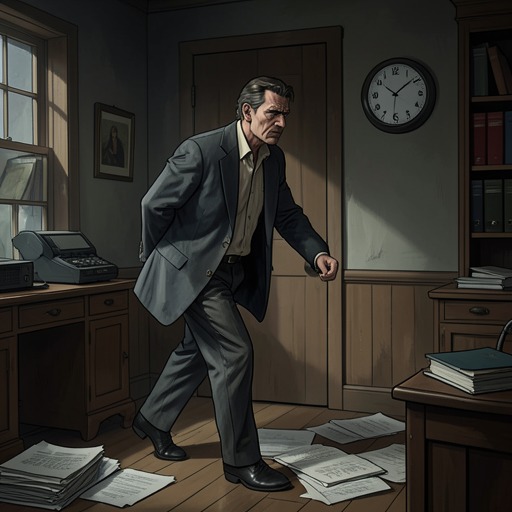
La piel del tamborPotro del Mantelete is a former bullfighter, boxer, and street confidence trickster whose stillness can look like stupidity until action is required. Scarred by failure and marked by a fatal act of violence, he is also defined by his absolute loyalty to Don Ibrahim and his quiet, courteous care for Niña Puñales. His story brings brutality and tenderness into the same frame: the man who once killed his brother pushes on with a disastrous church arson scheme, yet accompanies Niña through Seville’s Holy Week procession with solemn devotion.
Identity and Background
Around forty-five, Potro carries his past visibly. An unsuccessful youth as a novice bullfighter left him with the dust of minor arenas in his eyes and throat and a bull’s-horn scar beneath his right ear. Two spells in the Legion and an abortive bid to become Andalusia’s bantamweight champion brought him a broken nose, scarred, swollen brows, and slowed reflexes. He can take a long time to connect an action, a word, and a thought; in tourist scams, that very delay helps him play the helpless fool.
His apparent vacancy is not a simple mask. He may stand absorbed in a detail, such as the lipstick mark on Niña’s sherry glass, or remain motionless with a cigarette against the river’s glare. Don Ibrahim imagines him waiting for a bullring bell or trumpet to summon him into action, as if his thoughts had no motor. Yet the contrast between such passivity and his sudden, deliberate violence is central to his character.
Violence, Loyalty, and Don Ibrahim
Potro’s most consequential act before the church affair began in his own home. He came upon his paralysed brother in a wheelchair, his trousers around his knees, with Potro’s wife sitting on him. He listened without hurry as his brother called it a misunderstanding, then wheeled him almost tenderly to the landing and sent the chair—and its occupant—down thirty-two steps. His brother died of a fractured skull. Potro’s wife survived a methodical beating, recovered from a knockout within half an hour, and disappeared after packing her bags.
The prosecution sought thirty years, but Don Ibrahim, still accepted by Seville’s bar despite the doubtful Havana diploma he relied on, persuaded the judge to treat the death as accidental homicide rather than murder. The defence drew on the wrecked household, the brother’s infidelity, Potro’s limited intellectual capacity, the absence of intent to kill, and the wheelchair’s lack of brakes. The acquittal bound Potro to his defender with what the narration describes as an unbreakable, almost heroic fidelity. Even after Don Ibrahim was disgracefully expelled from the legal profession, Potro remained ready to do anything for a command or a caress from the man he regarded as his benefactor.
That allegiance is less a bargain than the one durable bond in Potro’s life. Don Ibrahim is proud of a loyalty that cannot be bought, and imagines that, when his own end comes, he could still claim to have had a faithful friend. Potro rarely explains himself: when asked to assess a plan, he may chew in silence for half a minute; when Don Ibrahim’s associates wait for his response, he eventually answers by echoing the words of others. His devotion shows itself more reliably in his readiness to stand beside his companions than in speech.
Companionship and the Holy Week Procession
Potro’s bond with Niña Puñales is expressed less through declarations than through small, formal acts of care. Though he is not religious, each Good Friday he puts on the old navy suit from his ill-fated wedding, buttons a white shirt to the collar, combs his hair with cologne, and walks beside her through Seville’s candlelight and drums behind the float of Esperanza. He gives her his arm and keeps pace while she prays in her black mantilla. Don Ibrahim, who does not join religious rites, watches them pass at dawn: Niña beneath the Virgin’s mantle, Potro quiet and steady at her side. The procession makes visible a fidelity distinct from obedience to Don Ibrahim—courtesy offered to a woman, year after year, in a ritual he does not himself share.
That same attentiveness appears when the pair tail Lorenzo Quart and Macarena through Santa Cruz. Niña has one arm in a sling after a burn, so Potro offers her his sound arm; in quiet streets she removes her high heels and follows barefoot, carrying her shoes. The pursuit is a practical assignment, but the narration lingers on the pair’s unhurried companionship: Potro’s serious, masculine bearing and courteous gesture become, for Niña, a tribute more valuable than words. He also spends his earnings from a street confidence trick on three shaded tickets for Sunday’s bullfight, making amends after the mishap with the anise liqueur. His concern appears in these modest accommodations and gifts, not in any spoken account of affection.
The Church Operation and Its Failures
Potro’s loyalty draws him into Don Ibrahim’s plan to set fire to the church, an act the partners frame as carrying out a crime commissioned by someone else. He raises no objection when the proposal is made, though the distinction between their own actions and their employer’s responsibility does not make him religious or reflective: he simply waits, fatalistic and faithful, for the cue to move. Niña Puñales refuses to take part in the actual arson, accepting only a supporting role; Potro, by contrast, remains available for whatever the others decide. The plan goes disastrously wrong when gasoline catches fire. Potro runs around the room with his left arm burning, while Niña uses a kitchen siphon to douse him and Don Ibrahim, then throws a blanket over the table. The fire leaves superficial burns, a damaged table, smoke on the ceiling, and the three partners ashamed before the neighbors and firefighters arrive. Potro is left with a bandaged arm, but none of them will speak of the mishap again.
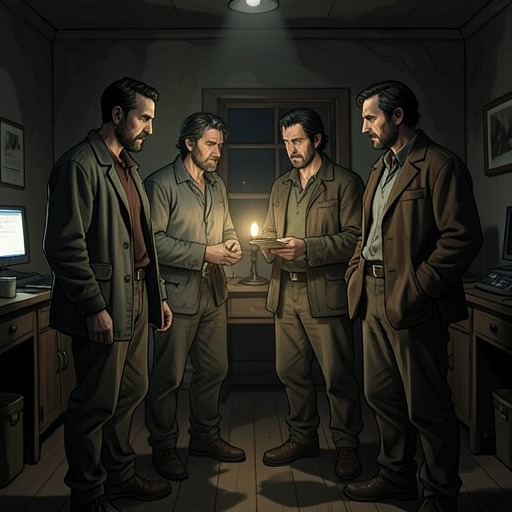
Their employer, Celestino Peregil, later rebukes the trio for making him look bad. Potro sits with his gaze fixed on the table, his burned hand still wrapped in gauze and ointment, while Niña drinks and Don Ibrahim studies the ash on his cigar. When Peregil asks whether they intend to abandon the job, Don Ibrahim answers that no one is backing out; Potro repeats the answer like an echo, looking toward a boxing-ring canvas. Peregil warns that time is running out and that Mass must not be celebrated in the church the following Thursday. Potro’s response is characteristic: not a plan or explanation, but a terse confirmation of solidarity.
Following Quart and the Abduction
Potro also joins Don Ibrahim and Niña in following Lorenzo Quart and Macarena through the crooked lanes of Santa Cruz. The surveillance demands patience and coordination: the companions take turns at the front, keep the pair in sight, and retreat hurriedly when the couple turns into a closed square. Potro and Niña lead at other moments, with Niña switching to her bare feet in quieter passages so her heels will not give them away. The same man who can be devastatingly violent at home is here attentive to the pace of an injured companion, offering his sound arm while she carries her shoes and a camera.
Later, the group holds a parish priest captive aboard a cabin. He remains blindfolded with Niña’s silk scarf and tied to a chair with broad adhesive tape bought the previous afternoon on Calle Pureza. When Peregil asks Potro how the priest is bearing the ordeal, Potro pauses, visibly puzzled, then looks to Don Ibrahim as a hound might look to its master for confirmation before answering a stranger. His damaged left forearm is still bandaged, and one eye bears an injury from the previous night’s scuffle. The scene makes his dependence on Don Ibrahim plain: even a simple question about the captive becomes something to interpret through the authority of his benefactor. No account of Potro’s later fate is given; his final appearance preserves the same mixture of physical damage, silence, and unquestioning allegiance that has governed his conduct throughout.